 0161 210 3766
How Do Air Source Heat Pumps Work? (And Why Most People Use Them Wrong)
Introduction
If you are asking how do air source heat pumps work, the simplest answer is this: they take heat from the outside air and move it into your home.
Unlike a gas boiler, an air source heat pump does not burn fuel. It uses electricity to collect existing heat energy from outside and transfer it indoors to heat your radiators, underfloor heating or hot water cylinder.
The important thing to understand is that heat pumps work best when they are used differently from boilers. Used correctly, they can provide steady comfort and efficient heating. Used like a boiler, they can become expensive and frustrating.
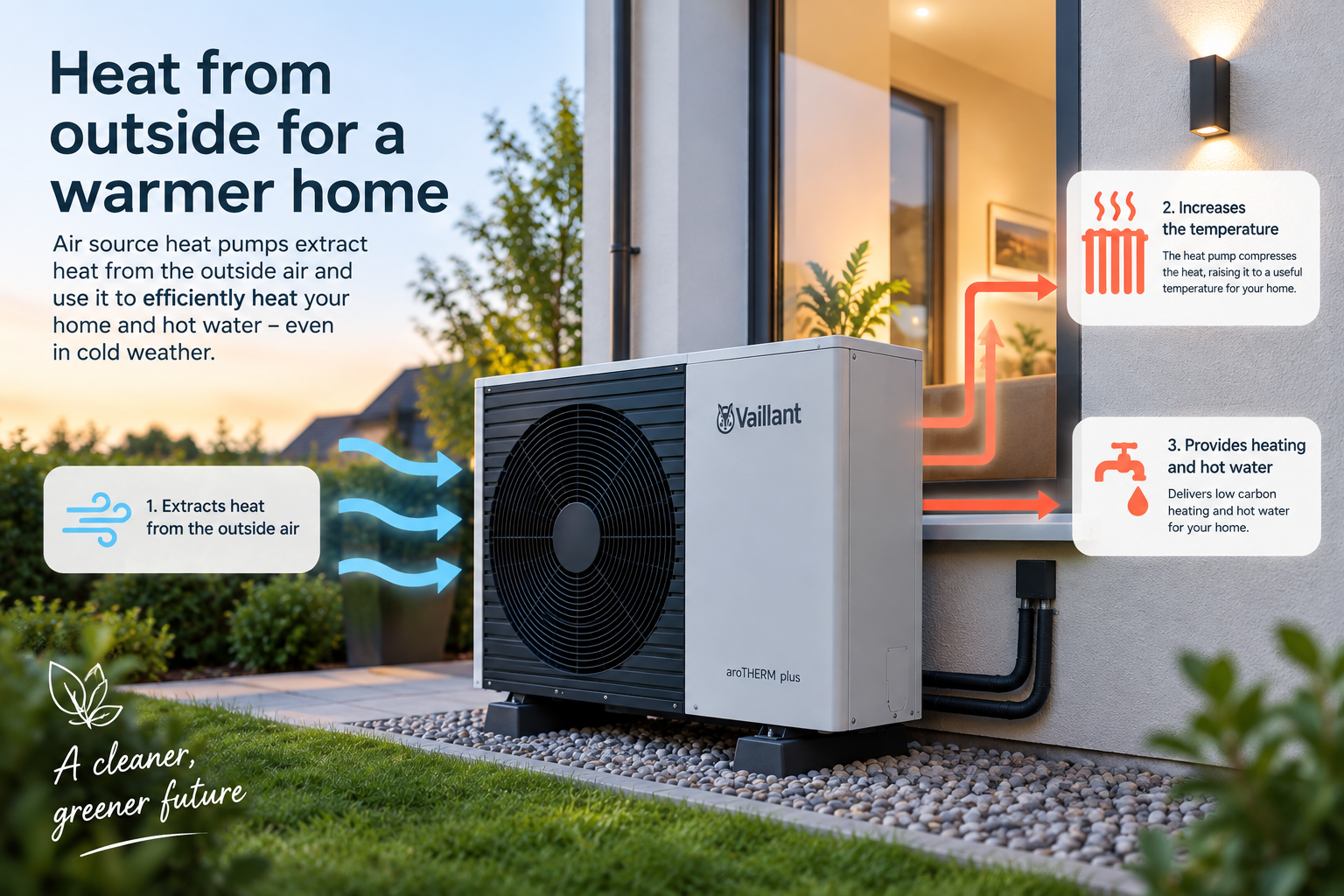

An air source heat pump is a heating system that extracts heat from the outside air and uses it to warm your home.
It usually has an outdoor unit with a fan, which looks a little like an air conditioning unit. This unit collects heat from the air, even when the weather is cold.
The heat is then transferred into your home and used for:
- radiators
- underfloor heating
- hot water cylinders
An air source heat pump works by moving heat rather than creating heat.
The process is broadly:
- The outdoor unit pulls in air.
- Heat energy is absorbed from that air.
- The heat pump upgrades that heat to a usable temperature.
- Warm water is sent around your heating system.
- Your home is kept warm steadily.
Even cold air contains heat energy. The heat pump captures that energy and transfers it into your home.


-
A gas boiler burns fuel to create high-temperature water. It is designed to send short, hot blasts of water around your radiators.
An air source heat pump works differently. Heat pumps should not be treated like boilers. It is most efficient when producing lower-temperature water over a longer period.
A boiler is usually used like this:
1. heating on
2. radiators very hot
3. house warms quickly
4. heating offA heat pump works best like this:
1. heating runs steadily
2. radiators stay warm rather than scorching hot
3. home temperature remains consistent
4. system avoids repeated stop-start cycles
The phrase low and slow is one of the easiest ways to understand heat pumps.
Heat pumps are normally most efficient when they send warm water around your heating system for longer periods, rather than very hot water for short bursts.
This matters because homes lose heat constantly through:
- walls
- roofs
- windows
- floors
- draughts
A heat pump works well when it gently replaces that lost heat throughout the day.
A useful comparison is a leaking bucket. Your home is the bucket, heat is the water, and the heat pump is a tap keeping the level topped up.
Many poor heat pump experiences happen because the system is controlled like a traditional boiler.
Common problems include:
- using short heating schedules
- turning the system on and off repeatedly
- setting high flow temperatures
- using thermostats as the main control
- closing too many TRVs
This can force the heat pump to work harder than necessary.
Instead of gently maintaining the home, it has to keep recovering from being switched off. That can mean higher running costs and poorer comfort.

You may have heard completely different stories about heat pumps.
Some people report cold homes and high bills. Others report warm homes and low running costs.
Both can be true.
The difference usually comes down to three things:
Design
The heat pump must be correctly sized for the home.
Setup
The system needs suitable settings, including flow temperature and weather compensation.
Knowledge
The householder needs to understand that a heat pump should usually be used differently from a boiler.
Air source heat pumps can be very efficient because they move heat rather than create it directly.
Their efficiency depends on:
- system design
- radiator or underfloor heating suitability
- flow temperature
- weather compensation settings
- insulation and draught levels
- how the system is controlled
The lower the flow temperature needed to keep the home warm, the more efficiently the heat pump can usually operate.
Frequently Asked Questions
How does an air source heat pump work in simple terms?
An air source heat pump takes heat from the outside air and moves it into your home. It uses electricity to transfer heat rather than burning gas to create heat.
Do air source heat pumps work in winter
Yes. Air source heat pumps can work in winter because even cold air contains heat energy. They simply need to work harder as outdoor temperatures fall.
Is an air source heat pump cheaper to run than a boiler?
It can be, but running costs depend on electricity prices, system design, insulation, flow temperature and how the heat pump is used.
Should I turn my heat pump off at night?
Often, it is better to reduce the temperature slightly rather than turn the heat pump fully off. Heat pumps are usually more efficient when maintaining warmth steadily.
Why are my radiators not very hot with a heat pump?
That is often normal. Heat pumps are designed to use lower radiator temperatures for longer periods. Warm radiators can be more efficient than very hot radiators.
What is the best way to use an air source heat pump?
The best approach is usually steady operation, low flow temperatures, weather compensation and avoiding unnecessary stop-start heating.
Air source heat pumps work by taking heat from the outside air and transferring it into your home.
They are different from boilers because they work best at lower temperatures over longer periods. Instead of short blasts of heat, they are designed to maintain a steady indoor temperature.
The best results usually come from:
- good system design
- correct setup
- weather compensation
- low flow temperatures
- steady operation
- householder understanding
Used properly, an air source heat pump can provide comfortable, efficient heating. Used like a boiler, it may cost more and perform poorly.